Advertising

Showing posts with label Arm Multicore. Show all posts

Tuesday, 13 December 2016

Unknown

Faster Windows 10 Mobile Devices Promised by Microsoft, Qualcomm

Microsoft said yesterday that it is paving the way for easier, faster Windows 10 computing on mobile devices with new support from Qualcomm's Snapdragon ARM processors. The partnership, announced at a Windows hardware engineering event in China, could lead to new mobile products running Windows 10 "as early as next year," according to Microsoft executive Terry Myerson.

The Windows 10-Snapdragon union could pose a threat to Intel's position as the market leader in PC chips, a number of observers have noted. At the same time, however, Microsoft yesterday also announced it was collaborating with Intel to bring new security and artificial-intelligence features to PCs, with a focus on gaming and mixed-reality applications.


Qualcomm's Snapdragon ARM processors
Together, developments like these could signal that significant shifts in the microprocessor market are on the horizon. They could also enable a second chance for Microsoft to bring the full Windows experience to mobile devices, an effort the company failed to achieve with its previous Window RT mobile operating system.

Targeting Windows Users on the Go
In a blog post about several announcements made yesterday in China, Myerson -- who is executive vice president for Microsoft's Windows and Devices Group -- said the new Snapdragon-powered collaboration with Qualcomm is aimed at meeting "our customers' growing needs to create on the go."

"For the first time ever, our customers will be able to experience the Windows they know with all the apps, peripherals, and enterprise Relevant Products/Services capabilities they require, on a truly mobile, power efficient, always-connected cellular PC," Myerson said. "With Windows 10 on cellular PCs, we will help everyone make the most of the air around them."

By using Qualcomm's ARM chips instead of Intel's X86-based processors, Microsoft hopes to enable a new generation of Windows 10-native mobile devices like tablets and laptops. Traditionally limited to low-power applications, ARM chips are becoming increasingly powerful and bring the added advantages of support for longer battery life and cellular-based, always-on connectivity.

Second Chance for Microsoft
Thanks to "compatibility with the Windows 10 ecosystem, the Qualcomm Snapdragon platform is expected to support mobility to cloud computing and redefine how people will use their compute devices," Qualcomm executive vice president Cristiano Amon said yesterday in a press announcement.

Myerson noted that the partnership will enable Microsoft's hardware partners to "build a range of new Qualcomm Snapdragon-powered Windows 10 PCs that run x86 Win32 and universal Windows apps, including Adobe Photoshop, Microsoft Office and popular Windows games."

Microsoft had previously targeted the mobile computing market with ARM-based devices running Windows RT, which launched in late 2012. However, that OS failed to gain traction among consumers, and production of Windows RT-based devices like the Surface 2 and Lumia 2520 tablets came to an end in early 2015.

Meanwhile, a new collaboration between Microsoft and Intel called Project Evo will aim to "further push the boundaries of personal computing" with smarter voice-machine communication, new virtual and mixed-reality applications, better gaming and "true always-connected computing," according to an editorial penned by Navin Shenoy, senior vice president and general manager of Intel's Client Computing Group.

"The work we are doing will help drive innovation in other areas too, from hardware-enhanced single- and multi-factor authentication powered by Windows Hello and Intel Authenticate for enhanced PC security to an even greater focus on connectivity -- starting today with LTE," Shenoy wrote. "This includes offering a wide range of PC form factors and price points that give people choice in mobility, whether they are carrying an ultra-thin and light notebook or a cool 2 in 1."
Read More

Thursday, 8 December 2016

Unknown

Qualcomm, Microsoft announce Windows 10 on ARM

Microsoft has announced a partnership with Qualcomm to bring Windows 10 - real Windows 10, not the aborted cut-down version formerly known as Windows RT - to the company's ARM processors.


Microsoft's previous attempts at playing with non-x86/AMD64 platforms have not exactly set the world aflame. The company has long offered an embedded Windows release which supports ARM and other non-x86/AMD64 architectures, and recently made that available to a wider audience under the moniker Windows 10 IoT Core. Although Windows 10 IoT Core does indeed run on ARM-based devices, in particular the popular Raspberry Pi single-board computer, it's not Windows as most users would know it; instead it's a cut-down operating system designed to run a single application at a time, and built with the intention of winning over embedded developers from Linux and other non-Windows kernels to the Windows ecosystem.


ARM processors
The closest Microsoft has ever come to a true release of a consumer-centric Windows version on ARM was Windows RT, launched alongside Windows 8 on Microsoft's Surface family of tablets. While one or two hardware partners licensed Windows RT, it was soon abandoned by both third parties and Microsoft itself: Microsoft confirmed in 2015 that Windows RT would not be updated to a Windows 10-based version, and sank the final nail into its coffin a few months later by leaving Windows RT out of its so-called 'Universal' Windows Platform.

Now, though, Microsoft is having another crack of the whip, and it's convinced Qualcomm to come along for the ride. Devices built around Qualcomm's latest Snapdragon processors will, the companies have jointly announced, be able to run Windows 10 - and this time it's truly the same release of Windows you'd find on an x86/AMD64 device. Not only will it run Windows 10, mind you, but also Windows 10's considerable ecosystem of applications - including those compiled exclusively for Win32 under the x86 architecture and the Universal Windows Platform.

'To deliver on our customers' growing needs to create on the go, we announced today that Windows 10 is coming to ARM through our partnership with Qualcomm,' explained Microsoft's Terry Myerson in a blog post late last night. 'For the first time ever, our customers will be able to experience the Windows they know with all the apps, peripherals, and enterprise capabilities they require, on a truly mobile, power efficient, always-connected cellular PC.'

Technical details of how the system will work have not yet been released, but the secret lies in emulation: a translation engine will take the x86/AMD64 instructions from the operating system and the software it's hosting and translate them into ARM instructions for the host processor. It's a tried-and-tested approach which gave machines like the Acorn Archimedes and Commodore Amiga basic x86 support in the 1980s and 1990s, though one which typically comes with a considerable performance hit - something for which Qualcomm's latest chips, it is to be hoped, can compensate.


A video demonstrating Windows 10 and Adobe Photoshop running on an ARM-based device is reproduced below, with Qualcomm and Microsoft promising to launch the first units some time next year.


Read More

Monday, 25 July 2016

Unknown

ARM chips: how they’ve changed your life

ARM microchips are used by millions of people to connect everyday devices and appliances over the internet. Arm’s designs lie at the heart of almost every smartphone sold today. Many cheaper phones use its off-the-shelf chips but for more sophisticated and expensive handsets, chipmakers often customise Arm’s technology to produce more distinctive features. With Intel backing out of the mobile processor market earlier this year to focus on servers, modems and the “internet of things”, there are few viable alternatives to Arm.

Television
Many modern televisions enable users to watch programmes and films through apps such as Netflix, which are powered by ARM-based processors. The firm’s technology is also frequently used in remote controls and set-top boxes.

Smartphones and tablets
ARM technology helps power both smartphones and iPads. E-readers, such as Kindles, and digital cameras also use the products.

Home ‘smart’ systems
Smart household appliances often use ARM-based chips to give homeowners greater control over their functions – and costs. This can include internet-connected thermostats, allowing users to control their heating via their smartphone, fridges that alert users when they have run out of groceries, and electricity metres that can help save money on energy bills.

Wearable gadgets
Fitness trackers and smart watches are becoming increasingly popular with consumers. These gadgets have relied on ARM technology for years.

Internal car systems
ARM-based chips are frequently used in cars to show drivers maps, offer voice recognition and to control music. They are also being used in prototypes for self-driving cars to power systems that trigger automatic electronic braking, for example. The technology could also be used in smart roads warning drivers about spots of black ice ahead.

Drones
Drones are becoming increasingly popular, be it families flying them in the park or photographers capturing aerial shots. They rely on tiny computers called microcontrollers and ARM estimates that a quarter of the chips made last year used its technology.

Energy efficient cities
Street lamps that dim themselves and parking meters that detect when spaces are empty are examples of sensors being used by cities to cut costs and help inhabitants. ARM believes this sector holds great potential for its business.

Read More

Thursday, 21 July 2016

Unknown

Cavium ThunderX block diagrams for its four families

During our work with the Cavium ThunderX platform, we have had access to a single 48-core ARMv8 2.0GHz SKU. Cavium’s strategy is to target different processor models into different market. Aside from clock speed and core count, Cavium has feature-based differentiation for its different ThunderX product families. We received permission to publish information on the different SKUs and their unique features.

The four Cavium ThunderX families (ThunderX_CP, ThunderX_ST, ThunderX_SC, ThunderX_NT) have a similar base architecture. From this common architecture, each chip is tailored to its targeted application. There are a few common underpinnings but this is the basic block diagram that shows all potential components of the platform.
The ThunderX_CP family is targeted at compute workloads. These chips target public and private clouds, web caching and web serving, search, social media and similar applications. The main accelerator in this family is the vSwitch Offload Engine. If you think about the application workload this is targeted at, one will take advantage of the high speed networking, multitude of cores and RAM bandwidth.
With Cavium’s strong networking portfolio as well as 16x SATA III 6.0gbps ports (60% more than a comparable Intel single socket system), storage is an application where the ThunderX architecture is well suited. The ThunderX_ST family targets block, object and distributed file storage workloads, distributed database applications and Hadoop style workloads. It comes in 8-48 core variants and has additional hardware accelerators such as the compression engine available.

Building on the high core count and the high-end networking throughput, the Cavium ThunderX_SC is focused on applications like eCommerce web servers. Cavium includes hardware accelerators for SSL, IPSec, deep packet inspection, anti-virus and anti-malware to free CPU cycles. Cavium has IP that it uses in dedicated Nitrox III chips that it leverages here.
With Cavium’s background as a networking company, and given the specs of the ThunderX chips, one area we think the company will do well in is in the networking and SP cloud space. The ThunderX_NT targets network function virtualization (NFV) servers and the telecom clouds being deployed with a mix of high bandwidth along with hardware accelerators. Like the storage family, the networking focused family can scale from 8-48 cores.

Final Words

We have been working with a single socket Cavium ThunderX machine, the Gigabyte R120-T30 server thus far and the results have been impressive. Cavium is embracing a different approach to product differentiation than Intel. While Intel is generally focused on raw x86 performance, Cavium’s SoC design allows it to differentiate on features. This can include networking, storage accelerators and other vectors. The Cavium ThunderX family is the first ARMv8 chip we have seen, in production, that can legitimately match and outpace parts of the Intel Xeon E5 line in terms of performance.


Read More

Monday, 13 June 2016

Unknown

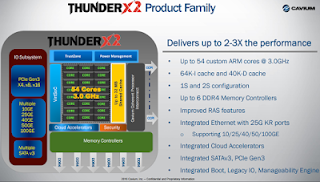
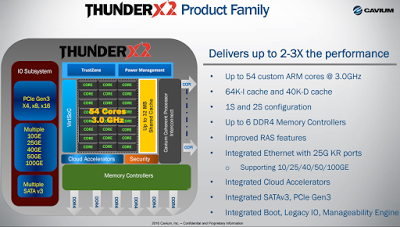
Cavium's 64-Bit ARM ThunderX2 Packs up to 54 Cores


Cavium unveiled its 64-bit ARM-basedThunderX2 processor for servers in cloud data centers used for workloads such as compute, security, storage, data analytics, network function virtualization (NFV) and distributed databases.

The second generation ARM processor from Cavium, which offers a number of on-board accelerators and advanced capabilities, packs up to 54 cores, enabling it to deliver two to three times the performance across a wide range of standard benchmarks and applications compared to ThunderX. It is built in 14nm FinFET process and is compliant with ARMv8.2 architecture as well as ARM's Server Base System Architecture (SBSA) standard.


Cavium ARM's Server Base System


Key ThunderX2 features will include:

  • 2nd generation of full custom Cavium ARM core: 2.4 to 2.8GHz in normal mode, Up to 3 GHz in Turbo mode; > 2X single thread performance compared to ThunderX.
  • Up to 54 cores per socket delivering 2-3X socket level performance compared to ThunderX.
  • Cache: 40K I-Cache and 64K D-cache, highly associative; 32MB shared Last Level Cache (LLC).
  • Single and dual socket configuration support using 2nd generation of Cavium Coherent Interconnect with > 2.5X coherent bandwidth compared to ThunderX.
  • System Memory: 6 DDR4 memory controllers per socket; Dual DIMM per memory controller, for a total of 12 DIMMs per socket.
  • Full system virtualization for low latency from virtual machine to IO enabled through Cavium virtSOC technology.
  • Integrated 10/25/40/50/100GbE network connectivity.
  • Multiple integrated SATAv3 interfaces.
  • Integrated PCIe Gen3 interfaces, x1, x4, x8 and x16 support.
  • Integrated Hardware Accelerators: OCTEON style packet parsing, shaping, lookup, QoS and forwarding; Virtual Switch (vSwitch) offload; Virtualization, storage and NITROX V security.
Four versions of the ThunderX2 will be offered:
·         ThunderX2_CP:  Optimized for cloud compute workloads such as private and public clouds, web serving, web caching, web search, commercial HPC workloads such as computational fluid dynamics (CFD) and reservoir modeling. This family supports multiple 10/25/40/50/100 GbE network Interfaces and PCIe Gen3 interfaces. It also includes accelerators for virtualization and vSwitch offload.
·         ThunderX2_ST: Optimized for big data, cloud storage, massively parallel processing (MPP) databases and Data warehousing workloads. This family supports multiple 10/25/40/50/100 GbE network interfaces, PCIe Gen3 interfaces and SATAv3 interfaces. It also includes hardware accelerators for data protection/ integrity/security, user to user efficient data movement.
·         ThunderX2_SC:  Optimized for secure web front-end, security appliances and cloud RAN type workloads. This family supports multiple 10/25/40/50/100 GbE interfaces and PCIe Gen3 interfaces. Integrated hardware accelerators include Cavium’s industry leading, 5th generation NITROX security technology with acceleration for IPSec, RSA and SSL.
·         ThunderX2_NT: Optimized for media servers, scale-out embedded applications and NFV type workloads. This family supports multiple 10/25/40/50/100 GbE interfaces. It also includes OCTEON style hardware accelerators for packet parsing, shaping, lookup, QoS and forwarding.
"ThunderX2 combines our next generation core that will deliver significantly higher single thread performance with next generation IO and hardware accelerators to provide a compelling value proposition for the server market and greatly expand the serviceable server TAM," said Syed Ali, President and CEO of Cavium. "ThunderX2 will enable flexible, scalable and fully optimizable servers for next generation software defined data centers."

Read More

Thursday, 6 November 2014

Unknown

Cavium Rolls Out ThunderX2 ARM Processor


Today Cavium announced ThunderX2, its second generation of Workload-Optimized ARM server SoCs. ThunderX2 targets high performance volume servers deployed by Public/Private Cloud and Telco data centers and high performance computing applications. It is optimized for key Data Center workloads such as compute, security, storage, data analytics, network function virtualization and distributed databases.


ARM-based server technologies
The Cavium ThunderX2 will expand the market opportunity for ARM-based server technologies by addressing demanding application and workload requirements for compute, storage networking and security,” said Simon Segars, CEO, ARM. “ThunderX2 demonstrates Cavium’s ability to deliver a combination of innovation and engineering execution and the new product family increases the momentum for server deployments powered by ARM processors in large scale data centers and end user environments.”
ThunderX2 will deliver two to three times the performance across a wide range of standard benchmarks and applications compared to ThunderX. It also significantly expands the market reach of the ThunderX family of processors by targeting applications that require high single thread performance such as web search, graph analytics, a variety of enterprise applications such as massively parallel processing (MPP) databases, data warehousing and enterprise HPC applications such as computational fluid dynamics (CFD) and reservoir modeling.
ThunderX2 will deliver comparable performance at a better total cost of ownership compared to the next generation of traditional server processors. ThunderX2 is the second generation Workload Optimized processor from Cavium. It is based on the latest ARMv8-A architecture and built on a 14nm FinFET process node. It is fully compliant with ARM’s Server Base System Architecture (SBSA) standard.

Key ThunderX2 features will include:
§  2nd generation of full custom Cavium ARM core o Multi-Issue, Fully OOO. o 2.4 to 2.8 GHz in normal mode, Up to 3 GHz in Turbo mode. o > 2X single thread performance compared to ThunderX.
§  Up to 54 cores per socket delivering 2-3X socket level performance compared to ThunderX
§  Cache o 64K I-Cache and 40K D-Cache, highly associative. o 32MB shared Last Level Cache (LLC).
§  Single and dual socket configuration support using 2nd generation of Cavium Coherent Interconnect with > 2.5X coherent bandwidth compared to ThunderX
§  System Memory o 6 DDR4 memory controllers per socket. o Dual DIMM per memory controller, for a total of 12 DIMMs per socket. o Up to 3200MHz in 1 DPC and 2966MHz in 2 DPC configuration. o Up to 3 TB of memory in dual socket configuration.
§  Full system virtualization for low latency from virtual machine to IO enabled through Cavium virtSOC technology
§  Next Generation IO o Integrated 10/25/40/50/100GbE network connectivity: Multiple integrated SATAv3 interfaces, Integrated PCIe Gen3 interfaces, x1, x4, x8 and x16 support.
§  Integrated Hardware Accelerators: OCTEON style packet parsing, shaping, lookup, QoS and forwarding, Virtual Switch (vSwitch) offload, Virtualization, storage and NITROX V security.

The ThunderX2 family of processors includes FOUR workload optimized processors targeting different workloads:
§  ThunderX2_CP: Optimized for cloud compute workloads such as private and public clouds, web serving, web caching, web search, commercial HPC workloads such as computational fluid dynamics (CFD) and reservoir modeling. This family supports multiple 10/25/40/50/100 GbE network Interfaces and PCIe Gen3 interfaces. It also includes accelerators for virtualization and vSwitch offload.
§  ThunderX2_ST: Optimized for big data, cloud storage, massively parallel processing (MPP) databases and Data warehousing workloads. This family supports multiple 10/25/40/50/100 GbE network interfaces, PCIe Gen3 interfaces and SATAv3 interfaces. It also includes hardware accelerators for data protection/ integrity/security, user to user efficient data movement.
§  ThunderX2_SC: Optimized for secure web front-end, security appliances and cloud RAN type workloads. This family supports multiple 10/25/40/50/100 GbE interfaces and PCIe Gen3 interfaces. Integrated hardware accelerators include Cavium’s industry leading, 5th generation NITROX security technology with acceleration for IPSec, RSA and SSL.
§  ThunderX2_NT: Optimized for media servers, scale-out embedded applications and NFV type workloads. This family supports multiple 10/25/40/50/100 GbE interfaces. It also includes OCTEON style hardware accelerators for packet parsing, shaping, lookup, QoS and forwarding. 

ThunderX2 combines our next generation core that will deliver significantly higher single thread performance with next generation IO and hardware accelerators to provide a compelling value proposition for the server market and greatly expand the serviceable server TAM,” said Syed Ali, President and CEO of Cavium. “ThunderX2 will enable flexible, scalable and fully optimizable servers for next generation software defined data centers.”

Cavium’s ThunderX2 SoC family is supported by a comprehensive software ecosystem ranging from platform level systems management and firmware to commercial Operating Systems, Development Environments and Applications. Cavium has actively engaged in server industry standards groups such as UEFI and delivered numerous reference platforms to a broad array of community and corporate partners. 

It is a honor to be able to rely on such a close business relationship with a partner like Cavium, we designed and delivered our own solutions based on Cavium ThunderX SoC for a while now, with extreme satisfaction in terms of performances, support and overall results. We can’t wait to get our hands the next gen SoC as we are confident it will provide an additional boost to an already strong and tested product line.” Cosimo Gianfreda, CTO E4 Computer Engineering. (Know more)
Read More