Advertising

Showing posts with label Arm Server Soc. Show all posts

Tuesday, 20 September 2016

Unknown

ARM Aims for Self-Driving Cars With New Safety-Focused SoC

The company's Cortex-R52 targets markets where safety is critical, including autonomous vehicles, robotics and health care.

ARM is looking to establish itself in the burgeoning autonomous car market with a new chip design that is aimed at addressing the high safety standards needed for not only driverless vehicles but also other areas such as industrial and medical robots.

ARM New Safety-Focused SoC
Company officials on Sept. 20 unveiled the Cortex-R52, a system-on-a-chip (SoC) design built on the company's ARMv8-R architecture that is designed to comply with a range of safety standards—such as ISO 26262 ASIL D and IEC 61508 SIL 3—that apply to situations in the growing internet of things (IoT), such as autonomous cars and robots in health care settings, where safety and security is paramount in the interaction between humans and machines.

The includes with robots that assist doctors in surgery to self-driving cars that need to understand the environment around them and immediately react to ensure the safety of the drivers and the people around the cars. In addition, the systems need to be highly secure to protect them against hackers.
"We are helping partners to meet particular market opportunities, especially in fully autonomous vehicles and robotics systems where specific functionality is required for safety-critical tasks," James McNiven, general manager for CPU and media processing groups at ARM, said in a statement.

The Challenges of Cloud Integration   Download Now    

Like other chip companies, ARM—which is being bought by Softbank for $32.2 billion—is working to branch out beyond its core markets to gain traction in a broad range of emerging growth areas being fueled by the rapid proliferation of connected devices, systems and sensors that make up the growing IoT. ARM designs SoCs and licenses those designs to a wide variety of chip manufacturers, such as Qualcomm, Samsung and Applied Micro. Most smartphones and tablets run on ARM-designed processors, but now company officials are looking to extend the reach of the architecture into other areas, from the data center to the IoT.

A growing number of ARM chip partners—including Qualcomm and Broadcom—are rolling out new products for the autonomous vehicle space. ARM also has been building up its capabilities in the IoT, including with the acquisition last year of Offspark, a company that specialized in security software for connected devices and sensors.
In a post on the company blog, James Scobie, a product manager at ARM, wrote about the growing demand for safety and security in IoT systems.

"Across multiple markets, electronic systems are becoming more complex—including automotive, industrial control and healthcare," Scobie wrote. "Vehicles are beginning to drive themselves, industrial robots are becoming increasingly collaborative, and medical systems are automated to assist with surgery or deliver medication. More of these systems are demanding functionally safe operation and requiring that functional safety be provided at a higher safety level than previous generations of systems demanded."

The Cortex-R52 architecture was created to address those functional safety needs, not only in self-driving cars, but also in increasingly automated factories that include autonomous robots that use machine learning and vision systems to enable them to work with less human control, he wrote.

"Outside the factory, robotics will be used in environments too harsh for humans, such as the nuclear industry, where there is a need to maintain precise and assured operation," Scobie wrote. "They can also be used in the medical operating theaters with remote surgery. In both areas, functionally safe operation is critical."

A key point in the Cortex-R52 is that there is what officials called hardware-enforced separation of various software tasks to make sure the code that is critical for safety is isolated. The hardware is managed by a software hypervisor. Not only does this ensure the protection of the code, but also lessens the amount of code that must be safety-certified, which makes software integration, maintenance and validation easier and development faster, they said.

"The Cortex-R52's ability to compartmentalize software provides our users with the best solution for safety without loss of determinism," Fabio Marchiò, vice president of STMicroelectronics' Automotive and Discrete Group and general manager of its Automotive Digital Division, said in a statement. "Its virtualization support simplifies the consolidation of applications and functions into a single processor, delivering a shorter integration time."
Read More

Thursday, 28 July 2016

Unknown

Azul Systems Announces Zulu® Embedded With Expanded Support for 32 and 64-bit Microprocessors

Support for 32-bit ARM® processors available immediately, with PowerPC and MIPS added to the Zulu Embedded roadmap


  • Azul is now the largest commercial vendor delivering multi-platform, 100% open source OpenJDK builds targeting embedded and IoT markets
  • Fully-supported Zulu Embedded builds of OpenJDK for 32-bit ARM processors are now available immediately
  • Zulu Embedded builds supporting 32-bit PowerPC processors will be delivered in Q3 2016, plus 64-bit ARM v8 support in Q1 2017
  • Supported operating systems include multiple Linux distros plus Windows 10 IoT 
SUNNYVALE, Calif.-- Azul Systems (Azul), the award-winning leader in Java runtime solutions, today announced Zulu Embedded with expanded support for multiple 32 and 64-bit embedded processors. Zulu Embedded, Azul's 100% open source Java Virtual Machine (JVM) based on OpenJDK, now includes support for ARM, Intel, PowerPC and MIPS processors. With today’s announcement, Azul is highlighting its full embedded Java SE roadmap, which spans a variety of processor architectures and operating systems, offers exceptional performance via optimized JIT compilation, supports various form factors and compact profiles, and provides a pure open source, standards-compliant solution for embedded Java.

General Availability: Zulu Embedded for ARM® V7 and V8

Zulu Embedded brings a variety of choices to product teams and manufacturers who integrate Java for their embedded and IoT-centric designs. Java is used virtually everywhere in the embedded world, ranging from manufacturing and logistics to security, networking, wireless, mobile and many other embedded applications.

Fully-supported Zulu Embedded builds of OpenJDK for 32-bit ARM are now available immediately, with builds supporting 32-bit PowerPC processors to be delivered in Q3 2016, plus 64-bit ARM v8 support in Q1 2017. Azul is also working with Cavium on Zulu Embedded support for 64-bit versions of the MIPS processor architecture. Zulu Embedded has supported both 32 and 64-bit x86 processors since its initial launch in early 2015.

“Highly efficient 32-bit ARM processors power a diverse range of embedded applications in automotive, TV, gateways, payment systems, and more," said Dominic Pajak, Marketing Director, Embedded Segments, ARM. "OpenJDK-based products like Zulu Embedded greatly enhance the Java development experience and add to the wide choices in the ARM ecosystem.”
“Azul’s Java expertise is well recognized in the industry, and the commitment to bring Zulu JVM to 64-bit ARMv8 and MIPS architectures will accelerate the efficiency and optimization of Java for Cavium customers,” said Larry Wikelius, Vice President Software Ecosystem and Solutions, Cavium. “Java based applications continue to be critical to our OCTEON® and ThunderX® installed base and Zulu will provide the commercial options that many end users require. Azul is a welcome addition to Cavium’s thriving software ecosystem partner community.”

“Java is a key enabling technology for the Internet of Things,” said Christian Renaud, Research Director, Internet of Things, 451 Research. “Many IoT applications demand real-time performance, and Zulu Embedded’s new support of 32-bit ARM architecture enables a number of opportunities and new applications in smart grid, healthcare, transportation, and many other applications.”

“Canonical and Azul are working together to ensure that Java developers building IoT solutions for Ubuntu Core can easily package their applications as snaps and incorporate Zulu Embedded using the new snapcraft tooling,” said Maarten Ectors, VP of IoT at Canonical.
"The Eclipse Foundation's Internet of Things Working Group has a number of Java-based open source IoT projects that will benefit from running on Zulu Embedded for 32-bit ARM processors. Zulu Embedded will be an important open source option for Java developers building IoT solutions," said Mike Milinkovich, Executive Director of Eclipse Foundation.

“Today’s announcement of the immediate availability of Zulu Embedded with support for 32-bit ARM processors and our extended embedded roadmap highlight Azul’s role as the industry’s leading provider of multi-platform, open source Java solutions,” said Scott Sellers, Azul Systems president and CEO. “The embedded and IoT markets are exploding with new products and devices, and Zulu Embedded provides the industry’s only open source, standards compliant solution for Java for these markets. By offering a wide range of processor and operating system support, and delivering customized builds to meet specific embedded requirements, Zulu Embedded is quickly become the de facto standard for developing and commercializing Java-based solutions in the embedded, maker and IoT markets.”

Read More

Thursday, 21 July 2016

Unknown

Cavium ThunderX block diagrams for its four families

During our work with the Cavium ThunderX platform, we have had access to a single 48-core ARMv8 2.0GHz SKU. Cavium’s strategy is to target different processor models into different market. Aside from clock speed and core count, Cavium has feature-based differentiation for its different ThunderX product families. We received permission to publish information on the different SKUs and their unique features.

The four Cavium ThunderX families (ThunderX_CP, ThunderX_ST, ThunderX_SC, ThunderX_NT) have a similar base architecture. From this common architecture, each chip is tailored to its targeted application. There are a few common underpinnings but this is the basic block diagram that shows all potential components of the platform.
The ThunderX_CP family is targeted at compute workloads. These chips target public and private clouds, web caching and web serving, search, social media and similar applications. The main accelerator in this family is the vSwitch Offload Engine. If you think about the application workload this is targeted at, one will take advantage of the high speed networking, multitude of cores and RAM bandwidth.
With Cavium’s strong networking portfolio as well as 16x SATA III 6.0gbps ports (60% more than a comparable Intel single socket system), storage is an application where the ThunderX architecture is well suited. The ThunderX_ST family targets block, object and distributed file storage workloads, distributed database applications and Hadoop style workloads. It comes in 8-48 core variants and has additional hardware accelerators such as the compression engine available.

Building on the high core count and the high-end networking throughput, the Cavium ThunderX_SC is focused on applications like eCommerce web servers. Cavium includes hardware accelerators for SSL, IPSec, deep packet inspection, anti-virus and anti-malware to free CPU cycles. Cavium has IP that it uses in dedicated Nitrox III chips that it leverages here.
With Cavium’s background as a networking company, and given the specs of the ThunderX chips, one area we think the company will do well in is in the networking and SP cloud space. The ThunderX_NT targets network function virtualization (NFV) servers and the telecom clouds being deployed with a mix of high bandwidth along with hardware accelerators. Like the storage family, the networking focused family can scale from 8-48 cores.

Final Words

We have been working with a single socket Cavium ThunderX machine, the Gigabyte R120-T30 server thus far and the results have been impressive. Cavium is embracing a different approach to product differentiation than Intel. While Intel is generally focused on raw x86 performance, Cavium’s SoC design allows it to differentiate on features. This can include networking, storage accelerators and other vectors. The Cavium ThunderX family is the first ARMv8 chip we have seen, in production, that can legitimately match and outpace parts of the Intel Xeon E5 line in terms of performance.


Read More

Wednesday, 20 July 2016

Unknown

Gigabyte and Cavium announce 14 ARM-based server products

Gigabyte and Cavium have announced a new lineup of products that provide “a compelling, high performance alternative” to the incumbent server technologies available on the market. In total 14 new server SKUs, leveraging Gigabyte’s server expertise and Cavium’s ThunderX ARM-based platform, have been announced.

Cavium’s ThunderX ARM-based platform
The Cavium ThunderX ARM 64-bit ARMv8 SOCs are described as workload optimised chips for data centre and cloud processing. They are available with up to 48 cores and in clock speeds of up to 2.5GHz. Gigabyte’s new servers are available in dual-socket configurations and allow for up to 2.0GHz clock speeds. Other key specs of Gigabyte’s market ready server products are:
  • The highest integrated I/O capability with up to 160Gb of I/O bandwidth
  • Four DDR4 72-bit memory controllers capable of supporting up to 1TB of memory in a dual socket configuration at 2133MHz
  • Best in class performance per watt and performance per dollar for storage and compute applications
  • A comprehensive range of designs, from cost-focused entry level solutions to high density storage and compute focused platforms
Adopters of the ‘disruptive’ new Cavium ThunderX based servers from Gigabyte will achieve similar performance but a “more compelling TCO” than using traditional x86 server systems. As well as the expected fanfare for these server products from hardware partners Gigabyte, Cavium, and ARM, industry big hitters such as Red Hat, Innodisk, SUSE and QLogic were among those to welcome the introduction of these servers.


Customers in the US, Europe and Asia are already starting to receive Cavium ThunderX based Gigabyte server products and they are available to order now. Cloud service providers have already demonstrated strong demand for the new SKUs says Gigabyte.


Read More
Unknown

Cavium Rolls Out ThunderX Servers with GIGABYTE Technology

Today GIGABYTE Technology and Cavium announced a new set of servers built on the industry-leading ThunderX family of workload-optimized ARM server SoCs. According to Cavium, the collaboration brings the world’s most powerful 64-bit ARM-based servers to market to address increasingly demanding application and workload requirements.

GIGABYTE Technology and Cavium

"The momentum for ARM-based servers is building and the new range of server products from GIGABYTE and Cavium enhances choice for companies seeking to match compute needs with the most energy and cost-effective solutions,” said Lakshmi Mandyam, senior marketing director of server program, ARM. “It is excellent to see ARM partners at the heart of driving innovative solutions that are delivering to the rigorous demands of cloud data center application and workload diversity.”

The server launch comes on the heels of news that ARM is being acquired by Softbank investment group in Japan. At a joint event in Shanghai, GIGABYTE and Cavium officially announced the release of a range of 14 server SKUs – the results of co-operation based on the Cavium ThunderX platform, utilizing GIGABYTE’s almost 20 years of experience in the server industry. With these products, the partnership has produced a compelling, high performance alternative to the incumbent solutions in the market. GIGABYTE and Cavium had the honor of inviting ecosystem partners – ARM, Innodisk, Linaro, Qlogic, Red Hat, and Suse – all of which have committed resource to bringing ARM-based servers to the mainstream enterprise market – as guest speakers at the event. GIGABYTE and Cavium are working with these stakeholders to bring higher performance-per-dollar to the server market and open up a range of potential new applications.

This solution targets high performance volume servers deployed by Public/Private Cloud and Telco data centers. It is optimized for key Data Center workloads including compute, security, storage, and distributed databases. GIGABYTE ThunderX servers deliver comparable performance at a more compelling TCO than traditional x86 server systems.

Key GIGABYTE ThunderX Server Features:
  • - Adoption of the first dual-socket ARM SoC architecture that scales up to 48 cores per processor with up to 2.0 GHz core frequency
  • - The highest integrated I/O capability with up to 160Gb of I/O bandwidth
  • - Four DDR4 72 bit memory controllers capable of supporting up to 1TB of memory in a dual socket configuration at 2133MHz
  • - Best in class performance per watt and performance per dollar for storage and compute applications
  • - A comprehensive range of designs, from cost-focused entry level solutions to high density storage and compute focused platforms
  • "GIGABYTE has developed and is already shipping a range of Cavium ThunderX-based server products to customers in US, Europe and Asia,” said Andy Chen, AVP, Network and Communications Business Unit, GIGABYTE. “Our comprehensive portfolio of ThunderX-based systems is available for order and a number of customers have already received production units. We are seeing strong demand for these ARM-based platforms – especially from cloud service providers".

Read More
Unknown

GIGABYTE and Cavium Announce Official Release of Production-Ready ThunderX®-based Servers

Collaboration brings the world's most powerful 64-bit ARM® based servers to market to address increasingly demanding application and workload requirements


SHANGHAI, China., July 19, 2016 –GIGABYTE Technology (TWSE: 2376), a leading manufacturer of motherboards and barebones for server applications, and Cavium Inc. (NASDAQ: CAVM), a leading provider of semiconductor products that enable intelligent processing for enterprise, cloud, and data center, today announced a line-up of products built on the industry-leading ThunderX  family of workload-optimized ARM server SoCs.

Cavium ThunderX platform
At a joint event in Shanghai, GIGABYTE and Cavium officially announced the release of a range of 14 server SKUs – the results of co-operation based on the Cavium ThunderX platform, utilizing GIGABYTE's almost 20 years of experience in the server industry. With these products, the partnership has produced a compelling, high performance alternative to the incumbent solutions in the market. GIGABYTE and Cavium had the honor of inviting ecosystem partners - ARM, Innodisk, Linaro, Qlogic, Red Hat, and Suse - all of which have committed resource to bringing ARM-based servers to the mainstream enterprise market - as guest speakers at the event. GIGABYTE and Cavium are working with these stakeholders to bring higher performance-per-dollar to the server market and open up a range of potential new applications.

Cavium ThunderX platform

This solution targets high performance volume servers deployed by Public/Private Cloud and Telco data centers. It is optimized for key Data Center workloads including compute, security, storage, and distributed databases. GIGABYTE ThunderX servers deliver comparable performance at a more compelling TCO than traditional x86 server systems.

Key GIGABYTE ThunderX Server Features
GIGABYTE has utilized its know-how to become the first and only server vendor to capture the benefits of Cavium’s revolutionary design and bring disruptive new solutions to the market through production-ready server products, which bring about:
  • - Adoption of the first dual-socket ARM SoC architecture that scales up to 48 cores per processor with up to 2.0 GHz core frequency
  • - The highest integrated I/O capability with up to 160Gb of I/O bandwidth
  • - Four DDR4 72 bit memory controllers capable of supporting up to 1TB of memory in a dual socket configuration at 2133MHz
  • - Best in class performance per watt and performance per dollar for storage and compute applications
  • - A comprehensive range of designs, from cost-focused entry level solutions to high density storage and compute focused platforms
"GIGABYTE has developed and is already shipping a range of Cavium ThunderX-based server products to customers in US, Europe and Asia," said Andy Chen, AVP, Network and Communications Business Unit, GIGABYTE. "Our comprehensive portfolio of ThunderX-based systems is available for order and a number of customers have already received production units. We are seeing strong demand for these ARM-based platforms – especially from cloud service providers."

A comprehensive ecosystem is key to the development of a market for ARM-based servers. To this end, we have been working with stakeholders across the value chain. GIGABYTE’s release partners contributed their views on co-operation and the market in general:

ARM:
"The momentum for ARM-based servers is building and the new range of server products from GIGABYTE and Cavium enhances choice for companies seeking to match compute needs with the most energy and cost-effective solutions,” said Lakshmi Mandyam, senior marketing director of server program, ARM. “It is excellent to see ARM partners at the heart of driving innovative solutions that are delivering to the rigorous demands of cloud data center application and workload diversity.”

CAVIUM:
“The ARM server market is beginning to expand and grow and mature” said Rishi Chugh, Director, Data Center Processor Group at Cavium. “GIGABYTE is the perfect partner to lead this effort and showcase the breadth of ThunderX-based workload optimized server platforms delivering the flexibility and performance required for next generation cloud data centers.”

Red Hat:
"Red Hat1 has been collaborating with GIGABYTE for quite some time via the Red Hat ARM Partner Early Access Program, as they worked to develop systems based on Cavium's ThunderX processor family," said Tim Burke, vice president, Linux Engineering, Red Hat. "These new, scalable servers serve as an excellent example of the technical innovation and standardization efforts within the growing ARM ecosystem. We are very pleased that as a result of our joint efforts we currently have Red Hat Enterprise Linux Server for ARM Development Preview running on GIGABYTE systems in lab and development environments."

Innodisk:
“Innodisk is a leading provider of industrial-grade storage solutions. Innodisk’s miniDIMM and RDIMM series solutions, especially aimed at server and telecommunication applications, have been certified by GIGABYTE and Cavium. Innodisk has collaborated with GIGABYTE and CAVIUM for years and looks forward to continuing to provide the best storage solutions in this field,” said Samson Chang, Vice President, Embedded DRAM division of Innodisk.

SUSE
“SUSE’s collaboration with Cavium and GIGABYTE has helped to bring AArch64 and cloud solutions to our customers, a development which is also highly meaningful for the development of the industry,” said Andy Jiang, Vice President, Asia Pacific & Japan General Manager with SUSE. “With the hyper-scale hardware of GIGABYTE, SUSE can now deliver the SUSE Linux Enterprise Server, SUSE Enterprise Storage and SUSE OpenStack Cloud to our clients. Cavium and GIGABYTE have demonstrated strong leadership in the ARM server market, and SUSE will work continue to closely with them.”

QLogic:
“The advent of data center-class ARM processors provide end users options to tailor hardware to suit specific workloads,” said Greg Scherer, vice president and CTO, QLogic. “The new ThunderX-based servers push the envelope of compute and drive the need for higher speed I/O.”

About GIGABYTE
GIGABYTE, headquartered in Taipei, Taiwan, is known as a global brand in the IT industry, with employees and business channels in almost every country. Founded in 1986, GIGABYTE started as a research and development team and has since taken the lead in the world's motherboard and graphics card markets.

On top of motherboards and graphics cards, GIGABYTE has become a leading producer of server hardware. Taking advantage of many years of know-how in motherboard design and manufacturing, GIGABYTE uses the most reliable components and aims for the highest quality standards only. This focus on excellence has allowed the company to work successfully with the biggest names in the server industry over the years, fueling its dedication to keep creating innovative server solutions for the future.

About Cavium
Cavium is a leading provider of highly integrated semiconductor products that enable intelligent processing in enterprise, data center, cloud, wired and wireless service provider applications. Cavium offers a broad portfolio of integrated, software compatible processors ranging in performance up to 100 Gbps that enable secure, intelligent functionality in enterprise, data center, broadband and access & service provider equipment. Cavium’s processors are supported by ecosystem partners that provide operating systems, tool support, reference designs and other services. Cavium’s principal offices are in San Jose, California with design team locations in California, Massachusetts, India, and China. For more information, please visit: http://www.Cavium.com.
GIGABYTE Contact
Stuart Coyle
Marketing Communications
Telephone: +886-2-8912-4000
Email:  stuart.coyle@GIGABYTE.com
Cavium Contact
Angel Atondo
Sr. Marketing Communications Manager
Telephone: +1 408-943-7417
Email: angel.atondo@cavium.com

Read More

Monday, 13 June 2016

Unknown

Cavium's 64-Bit ARM ThunderX2 Packs up to 54 Cores


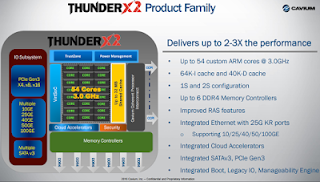
Cavium unveiled its 64-bit ARM-basedThunderX2 processor for servers in cloud data centers used for workloads such as compute, security, storage, data analytics, network function virtualization (NFV) and distributed databases.

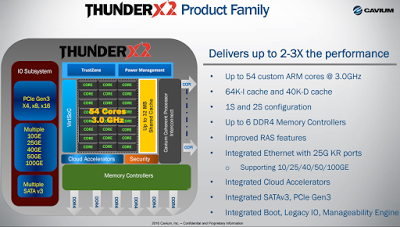
The second generation ARM processor from Cavium, which offers a number of on-board accelerators and advanced capabilities, packs up to 54 cores, enabling it to deliver two to three times the performance across a wide range of standard benchmarks and applications compared to ThunderX. It is built in 14nm FinFET process and is compliant with ARMv8.2 architecture as well as ARM's Server Base System Architecture (SBSA) standard.


Cavium ARM's Server Base System


Key ThunderX2 features will include:

  • 2nd generation of full custom Cavium ARM core: 2.4 to 2.8GHz in normal mode, Up to 3 GHz in Turbo mode; > 2X single thread performance compared to ThunderX.
  • Up to 54 cores per socket delivering 2-3X socket level performance compared to ThunderX.
  • Cache: 40K I-Cache and 64K D-cache, highly associative; 32MB shared Last Level Cache (LLC).
  • Single and dual socket configuration support using 2nd generation of Cavium Coherent Interconnect with > 2.5X coherent bandwidth compared to ThunderX.
  • System Memory: 6 DDR4 memory controllers per socket; Dual DIMM per memory controller, for a total of 12 DIMMs per socket.
  • Full system virtualization for low latency from virtual machine to IO enabled through Cavium virtSOC technology.
  • Integrated 10/25/40/50/100GbE network connectivity.
  • Multiple integrated SATAv3 interfaces.
  • Integrated PCIe Gen3 interfaces, x1, x4, x8 and x16 support.
  • Integrated Hardware Accelerators: OCTEON style packet parsing, shaping, lookup, QoS and forwarding; Virtual Switch (vSwitch) offload; Virtualization, storage and NITROX V security.
Four versions of the ThunderX2 will be offered:
·         ThunderX2_CP:  Optimized for cloud compute workloads such as private and public clouds, web serving, web caching, web search, commercial HPC workloads such as computational fluid dynamics (CFD) and reservoir modeling. This family supports multiple 10/25/40/50/100 GbE network Interfaces and PCIe Gen3 interfaces. It also includes accelerators for virtualization and vSwitch offload.
·         ThunderX2_ST: Optimized for big data, cloud storage, massively parallel processing (MPP) databases and Data warehousing workloads. This family supports multiple 10/25/40/50/100 GbE network interfaces, PCIe Gen3 interfaces and SATAv3 interfaces. It also includes hardware accelerators for data protection/ integrity/security, user to user efficient data movement.
·         ThunderX2_SC:  Optimized for secure web front-end, security appliances and cloud RAN type workloads. This family supports multiple 10/25/40/50/100 GbE interfaces and PCIe Gen3 interfaces. Integrated hardware accelerators include Cavium’s industry leading, 5th generation NITROX security technology with acceleration for IPSec, RSA and SSL.
·         ThunderX2_NT: Optimized for media servers, scale-out embedded applications and NFV type workloads. This family supports multiple 10/25/40/50/100 GbE interfaces. It also includes OCTEON style hardware accelerators for packet parsing, shaping, lookup, QoS and forwarding.
"ThunderX2 combines our next generation core that will deliver significantly higher single thread performance with next generation IO and hardware accelerators to provide a compelling value proposition for the server market and greatly expand the serviceable server TAM," said Syed Ali, President and CEO of Cavium. "ThunderX2 will enable flexible, scalable and fully optimizable servers for next generation software defined data centers."

Read More

Thursday, 6 November 2014

Unknown

Cavium Rolls Out ThunderX2 ARM Processor


Today Cavium announced ThunderX2, its second generation of Workload-Optimized ARM server SoCs. ThunderX2 targets high performance volume servers deployed by Public/Private Cloud and Telco data centers and high performance computing applications. It is optimized for key Data Center workloads such as compute, security, storage, data analytics, network function virtualization and distributed databases.


ARM-based server technologies
The Cavium ThunderX2 will expand the market opportunity for ARM-based server technologies by addressing demanding application and workload requirements for compute, storage networking and security,” said Simon Segars, CEO, ARM. “ThunderX2 demonstrates Cavium’s ability to deliver a combination of innovation and engineering execution and the new product family increases the momentum for server deployments powered by ARM processors in large scale data centers and end user environments.”
ThunderX2 will deliver two to three times the performance across a wide range of standard benchmarks and applications compared to ThunderX. It also significantly expands the market reach of the ThunderX family of processors by targeting applications that require high single thread performance such as web search, graph analytics, a variety of enterprise applications such as massively parallel processing (MPP) databases, data warehousing and enterprise HPC applications such as computational fluid dynamics (CFD) and reservoir modeling.
ThunderX2 will deliver comparable performance at a better total cost of ownership compared to the next generation of traditional server processors. ThunderX2 is the second generation Workload Optimized processor from Cavium. It is based on the latest ARMv8-A architecture and built on a 14nm FinFET process node. It is fully compliant with ARM’s Server Base System Architecture (SBSA) standard.

Key ThunderX2 features will include:
§  2nd generation of full custom Cavium ARM core o Multi-Issue, Fully OOO. o 2.4 to 2.8 GHz in normal mode, Up to 3 GHz in Turbo mode. o > 2X single thread performance compared to ThunderX.
§  Up to 54 cores per socket delivering 2-3X socket level performance compared to ThunderX
§  Cache o 64K I-Cache and 40K D-Cache, highly associative. o 32MB shared Last Level Cache (LLC).
§  Single and dual socket configuration support using 2nd generation of Cavium Coherent Interconnect with > 2.5X coherent bandwidth compared to ThunderX
§  System Memory o 6 DDR4 memory controllers per socket. o Dual DIMM per memory controller, for a total of 12 DIMMs per socket. o Up to 3200MHz in 1 DPC and 2966MHz in 2 DPC configuration. o Up to 3 TB of memory in dual socket configuration.
§  Full system virtualization for low latency from virtual machine to IO enabled through Cavium virtSOC technology
§  Next Generation IO o Integrated 10/25/40/50/100GbE network connectivity: Multiple integrated SATAv3 interfaces, Integrated PCIe Gen3 interfaces, x1, x4, x8 and x16 support.
§  Integrated Hardware Accelerators: OCTEON style packet parsing, shaping, lookup, QoS and forwarding, Virtual Switch (vSwitch) offload, Virtualization, storage and NITROX V security.

The ThunderX2 family of processors includes FOUR workload optimized processors targeting different workloads:
§  ThunderX2_CP: Optimized for cloud compute workloads such as private and public clouds, web serving, web caching, web search, commercial HPC workloads such as computational fluid dynamics (CFD) and reservoir modeling. This family supports multiple 10/25/40/50/100 GbE network Interfaces and PCIe Gen3 interfaces. It also includes accelerators for virtualization and vSwitch offload.
§  ThunderX2_ST: Optimized for big data, cloud storage, massively parallel processing (MPP) databases and Data warehousing workloads. This family supports multiple 10/25/40/50/100 GbE network interfaces, PCIe Gen3 interfaces and SATAv3 interfaces. It also includes hardware accelerators for data protection/ integrity/security, user to user efficient data movement.
§  ThunderX2_SC: Optimized for secure web front-end, security appliances and cloud RAN type workloads. This family supports multiple 10/25/40/50/100 GbE interfaces and PCIe Gen3 interfaces. Integrated hardware accelerators include Cavium’s industry leading, 5th generation NITROX security technology with acceleration for IPSec, RSA and SSL.
§  ThunderX2_NT: Optimized for media servers, scale-out embedded applications and NFV type workloads. This family supports multiple 10/25/40/50/100 GbE interfaces. It also includes OCTEON style hardware accelerators for packet parsing, shaping, lookup, QoS and forwarding. 

ThunderX2 combines our next generation core that will deliver significantly higher single thread performance with next generation IO and hardware accelerators to provide a compelling value proposition for the server market and greatly expand the serviceable server TAM,” said Syed Ali, President and CEO of Cavium. “ThunderX2 will enable flexible, scalable and fully optimizable servers for next generation software defined data centers.”

Cavium’s ThunderX2 SoC family is supported by a comprehensive software ecosystem ranging from platform level systems management and firmware to commercial Operating Systems, Development Environments and Applications. Cavium has actively engaged in server industry standards groups such as UEFI and delivered numerous reference platforms to a broad array of community and corporate partners. 

It is a honor to be able to rely on such a close business relationship with a partner like Cavium, we designed and delivered our own solutions based on Cavium ThunderX SoC for a while now, with extreme satisfaction in terms of performances, support and overall results. We can’t wait to get our hands the next gen SoC as we are confident it will provide an additional boost to an already strong and tested product line.” Cosimo Gianfreda, CTO E4 Computer Engineering. (Know more)
Read More