Advertising

Showing posts with label ARM processors. Show all posts

Wednesday, 14 December 2016

Unknown

Microsoft to bring full Windows experience on mobile phones

Apps on the x86 architecture have mostly been limited to desktop processors - until now. At the 2016 WinHEC Conference in China, Microsoft announced that ARM processors will soon be able to run the full desktop experience of Windows.

Microsoft to bring full Windows experience on mobile phones

During the Windows 8 time frame, as The Verge recounted, Microsoft implemented Windows on ARM under Windows RT, which proved to be unpopular since RT was only capable of running apps from the Windows store - that meant no x86 apps.

This has been rectified with the software giant's partnership with Qualcomm. Through emulation that is built into Windows 10, ARM processors will be able to run x86 win32 programs.

Executive Vice President Terry Myerson noted on Windows Blog: "For the first time ever, our customers will be able to experience the Windows they know with all the apps, peripherals, and enterprise capabilities they require, on a truly mobile, power efficient, always-connected cellular PC."

With a Snapdragon chipset, Microsoft demoed Windows 10 on ARM running the desktop Office suite, Adobe Photoshop, and Halo Spartan Assault. This showed how easily desktop apps might be handled on laptops and tablets by hardware partners, and even phones with Continuum, all the while taking advantage of the light footprint that mobile processors provide.

Lumia 950 XL release with Continuum, a feature of Windows 10 Mobile that let's phone act like computers when connected to a display. While Microsoft did not discuss Continuum in relation to this x86 emulation, this ARM implementation of Windows 10 could make Continuum that much more potent.
As it stands, Continuum for Windows 10 Mobile can only be taken advantage of using apps specifically design under the Universal Windows Platform (UWP) architecture, but Windows 10 on ARM can bring desktop apps to phones.

Windows 10's support for ARM processors is set to release next year. Stay tuned for more exciting updates!        

Read More

Tuesday, 13 December 2016

Unknown

Faster Windows 10 Mobile Devices Promised by Microsoft, Qualcomm

Microsoft said yesterday that it is paving the way for easier, faster Windows 10 computing on mobile devices with new support from Qualcomm's Snapdragon ARM processors. The partnership, announced at a Windows hardware engineering event in China, could lead to new mobile products running Windows 10 "as early as next year," according to Microsoft executive Terry Myerson.

The Windows 10-Snapdragon union could pose a threat to Intel's position as the market leader in PC chips, a number of observers have noted. At the same time, however, Microsoft yesterday also announced it was collaborating with Intel to bring new security and artificial-intelligence features to PCs, with a focus on gaming and mixed-reality applications.


Qualcomm's Snapdragon ARM processors
Together, developments like these could signal that significant shifts in the microprocessor market are on the horizon. They could also enable a second chance for Microsoft to bring the full Windows experience to mobile devices, an effort the company failed to achieve with its previous Window RT mobile operating system.

Targeting Windows Users on the Go
In a blog post about several announcements made yesterday in China, Myerson -- who is executive vice president for Microsoft's Windows and Devices Group -- said the new Snapdragon-powered collaboration with Qualcomm is aimed at meeting "our customers' growing needs to create on the go."

"For the first time ever, our customers will be able to experience the Windows they know with all the apps, peripherals, and enterprise Relevant Products/Services capabilities they require, on a truly mobile, power efficient, always-connected cellular PC," Myerson said. "With Windows 10 on cellular PCs, we will help everyone make the most of the air around them."

By using Qualcomm's ARM chips instead of Intel's X86-based processors, Microsoft hopes to enable a new generation of Windows 10-native mobile devices like tablets and laptops. Traditionally limited to low-power applications, ARM chips are becoming increasingly powerful and bring the added advantages of support for longer battery life and cellular-based, always-on connectivity.

Second Chance for Microsoft
Thanks to "compatibility with the Windows 10 ecosystem, the Qualcomm Snapdragon platform is expected to support mobility to cloud computing and redefine how people will use their compute devices," Qualcomm executive vice president Cristiano Amon said yesterday in a press announcement.

Myerson noted that the partnership will enable Microsoft's hardware partners to "build a range of new Qualcomm Snapdragon-powered Windows 10 PCs that run x86 Win32 and universal Windows apps, including Adobe Photoshop, Microsoft Office and popular Windows games."

Microsoft had previously targeted the mobile computing market with ARM-based devices running Windows RT, which launched in late 2012. However, that OS failed to gain traction among consumers, and production of Windows RT-based devices like the Surface 2 and Lumia 2520 tablets came to an end in early 2015.

Meanwhile, a new collaboration between Microsoft and Intel called Project Evo will aim to "further push the boundaries of personal computing" with smarter voice-machine communication, new virtual and mixed-reality applications, better gaming and "true always-connected computing," according to an editorial penned by Navin Shenoy, senior vice president and general manager of Intel's Client Computing Group.

"The work we are doing will help drive innovation in other areas too, from hardware-enhanced single- and multi-factor authentication powered by Windows Hello and Intel Authenticate for enhanced PC security to an even greater focus on connectivity -- starting today with LTE," Shenoy wrote. "This includes offering a wide range of PC form factors and price points that give people choice in mobility, whether they are carrying an ultra-thin and light notebook or a cool 2 in 1."
Read More

Thursday, 8 December 2016

Unknown

Qualcomm, Microsoft announce Windows 10 on ARM

Microsoft has announced a partnership with Qualcomm to bring Windows 10 - real Windows 10, not the aborted cut-down version formerly known as Windows RT - to the company's ARM processors.


Microsoft's previous attempts at playing with non-x86/AMD64 platforms have not exactly set the world aflame. The company has long offered an embedded Windows release which supports ARM and other non-x86/AMD64 architectures, and recently made that available to a wider audience under the moniker Windows 10 IoT Core. Although Windows 10 IoT Core does indeed run on ARM-based devices, in particular the popular Raspberry Pi single-board computer, it's not Windows as most users would know it; instead it's a cut-down operating system designed to run a single application at a time, and built with the intention of winning over embedded developers from Linux and other non-Windows kernels to the Windows ecosystem.


ARM processors
The closest Microsoft has ever come to a true release of a consumer-centric Windows version on ARM was Windows RT, launched alongside Windows 8 on Microsoft's Surface family of tablets. While one or two hardware partners licensed Windows RT, it was soon abandoned by both third parties and Microsoft itself: Microsoft confirmed in 2015 that Windows RT would not be updated to a Windows 10-based version, and sank the final nail into its coffin a few months later by leaving Windows RT out of its so-called 'Universal' Windows Platform.

Now, though, Microsoft is having another crack of the whip, and it's convinced Qualcomm to come along for the ride. Devices built around Qualcomm's latest Snapdragon processors will, the companies have jointly announced, be able to run Windows 10 - and this time it's truly the same release of Windows you'd find on an x86/AMD64 device. Not only will it run Windows 10, mind you, but also Windows 10's considerable ecosystem of applications - including those compiled exclusively for Win32 under the x86 architecture and the Universal Windows Platform.

'To deliver on our customers' growing needs to create on the go, we announced today that Windows 10 is coming to ARM through our partnership with Qualcomm,' explained Microsoft's Terry Myerson in a blog post late last night. 'For the first time ever, our customers will be able to experience the Windows they know with all the apps, peripherals, and enterprise capabilities they require, on a truly mobile, power efficient, always-connected cellular PC.'

Technical details of how the system will work have not yet been released, but the secret lies in emulation: a translation engine will take the x86/AMD64 instructions from the operating system and the software it's hosting and translate them into ARM instructions for the host processor. It's a tried-and-tested approach which gave machines like the Acorn Archimedes and Commodore Amiga basic x86 support in the 1980s and 1990s, though one which typically comes with a considerable performance hit - something for which Qualcomm's latest chips, it is to be hoped, can compensate.


A video demonstrating Windows 10 and Adobe Photoshop running on an ARM-based device is reproduced below, with Qualcomm and Microsoft promising to launch the first units some time next year.


Read More

Monday, 24 October 2016

Unknown

SoC Solutions joins asicNorth's IoT Design Ecosystem

Suwanee, GA, October 24, 2016 - SoC Solutions is teaming with asicNorth as part of a complete development ecosystem for custom Internet of Things (IoT) devices. Joining SoC Solutions and asicNorth are Faraday Technology, Silicon Creations, and UMC. Each company offers valuable expertise in key areas such as system design, semiconductor design, and process technology areas. “By bringing together the unique expertise of the companies, asicNorth is able to offer IoT customers a streamlined platform for the creation of fully integrated devices for the IoT chip marketplace,” commented Mike Slattery, President of asicNorth.

IoT chip marketplace

“SoC Solutions is very excited to become a partner of the asicNorth ‘IoT Design EcoSystem’”, says Jim Bruister President/CEO. “Our more than 25 years of experience developing ARM based subsystems and software combined with asicNorth’s excellence in producing quality mixed signal designs is perfect for servicing the IoT market.” “asicNorth is pleased to offer this new capability to our customers” says Steve Stratz, VP. “By aligning ourselves with such strong players in the system design, semiconductor design and manufacturing community, we can collectively help our customers to bring better IoT device solutions to market.”

ARM TechCon 2016 Exhibiting Announcement

In an effort to showcase the newly created asicNorth’s “IoT Design EcoSystem”, Soc Solutions will be joining asicNorth at the ARM TechCon October 26th and October 27th, 2016 in Santa Clara, CA. ARM TechCon’s conference program is built to ignite understanding and innovation across the embedded systems industry, connecting thought leaders and professionals from around the country in order to push tomorrow’s industry today. It’s an unmatched opportunity to share ideas, gather insight, and discover inspiration for your next project. By offering three full days of technical tracks, demonstrations, and industry insight from broad and deep levels of industry-leading companies and innovative start-ups, ARM TechCon remains more than a tradeshow; it is a comprehensive learning environment for the entire embedded community, uniting the software and hardware communities. The conference also hosts a large commercial exhibition featuring over 100 companies.

Come visit us at booth #917.

About ASIC North:
ASIC North, INC was founded in January 2000 with one purpose in mind; to deliver the highest quality design services possible. In an industry that can be quite volatile at times, it is important to have a design partner that you can depend upon to deliver the skills you need when you need them. Today, asicNorth is enabling high-tech industry leaders and startups alike with a combination of design services in digital, analog, mixed-signal, and RF design. These capabilities, along with our focus on IP Design, Circuit Characterization; Supply Chain Management; and Turnkey Products allow us to support the needs of our clients at any point in the IC product development cycle. asicNorth is “Bringing Analog / Mixed-Signal to ASIC Design”. To learn more about asicNorth, visit us at www.asicNorth.com.
Read More

Wednesday, 21 September 2016

Unknown

ARM upgrades realtime offerings to v8-R and adds Cortex-R52

Four cores with a lot of enhancements for safety critical users
ARM has introduced a new realtime core and architecture, lets welcome the new v8-R and Cortex-R52. If you are into realtime processors this is a big deal, if not, you will probably use one anyway.
Until now the -R line of ARM cores was based on the v7-R ISA with three prominent members, the R7 and R8 lines for storage and modem type work and the R5 for safety critical applications. The former pair needs hard realtime functionality, the latter needs that and safety critical certifications. While you want your HDD reads to be reliable, you want your antilock braking system to be a whole other level of reliable. And certified. And really mean it. Think ASIL-D and related safety specs for a starting point.

It is this latter arena where the new R52 core plays, it is a safety critical hard realtime core with the need for more performance without sacrificing reliability or functionality. The new v8-R ISA brings a lot to the table here in three main groups, added functionality, lowered latency, and ease of use. One thing that you probably assumed are 64-bit functions based on the v8- part but v8-R is still only 32-bit. In the world the -R cores play in this isn’t a problem at all, it isn’t and never will be a consumer oriented core.

ARM upgrades realtime offerings to v8-R and adds Cortex-R52
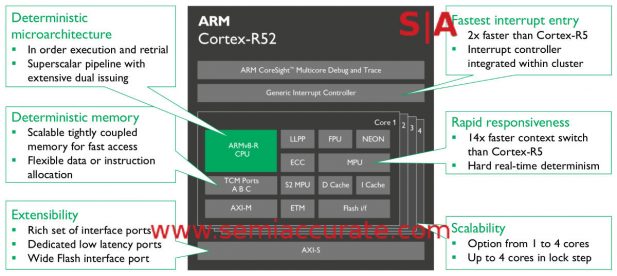
                                               The block diagram of the Cortex-R52


On the surface the R52 looks pretty familiar, four clustered cores, AXI-5 bus, and bunch of memory options. When you dig a little deeper you start seeing differences like the debug and trace block plus an interrupt controller directly on the cluster of CPUs. Even with all of this, v8-R is code directly compatible with v7-R so no rewrite worries for your embedded and certified code. Lets take a look at the high points above and the difference a two makes when going from an R5 to an R52 other than the “up to 35%’ performance uplift”.

First of all there is the deterministic architecture top to bottom which kind of necessitates in-order execution. The R52 is superscalar but it is still in-order so no problems there. What is a really odd addition for those coming from the -A or generalized CPU world is the deterministic memory portion. If you need realtime operation, memory accesses can be a problem. The R52 solves this by adding three TCM or Tightly Coupled Memory ports. If you have an SOC or system you can know your memory latency and adjust your code accordingly. This goes a long way towards a usable deterministic architecture and does a lot to fix memory latency. By fix we mean make consistent, not remove.

Latency is also addressed with the integrated interrupt controller on the cluster. ARM claims what was ~66 cycles of latency for an interrupt with an external IC is now ~27 cycles with the new way. If you think about how a realtime core works, basically sitting in a wait loop until it gets interrupted, this is a massive gain in performance for the system. Similarly a full context switch for a core is now a huge 14x faster than before. More interestingly this latency reduction is not code visible so no changes needed there. Changes in this realm are both costly and require re-certification so again this is a huge win.

On the functionality side there are a lot of improvements too, starting with added crypto instructions. This is necessary to prevent government agencies from illegally recording your antilock brake controller to dashboard blinky-light data stream. That is a joke but we assume there is a need for encryption on a lot of safety critical devices, with the R52 core you now have it along with a few lesser added instructions.

A lot of the new functionality comes from a new privilege level called EL2 which essentially allows v8-R devices to run a hypervisor. We won’t go into why a hypervisor is useful in this realm, it should be pretty obvious. One thing it does do is allow non-realtime and non-safety critical code to run on the same SoC without as much fear but there are probably much better ways to accomplish the same goal. Since the R52 has an AXI-5 bus, you could just add a -M or -A class cluster on the bus and run your movies or infotainment system on that.

Four cores plus a hypervisor in a realtime system essentially equals four discrete systems with nearly ironclad process separation, a really good basis for backup processes, checksums, multiple iterations of the same thing for failovers. Going one step further ARM has put lockstep modes in R52 so you can have two cores each with a shadow core running automatically. Once again this will save SoC designers a lot of headaches because it is not only done for them but done in a standardized way. One thing the R52 can not do is operate in 3-way lockstep for voting type operations but if you need it, you can implement it yourself.

The ease of use bit is a little harder to explain if you are not familiar with realtime cores and programming. In this world code is chunked into regions which are effectively hard separated from each other. You don’t really switch tasks as much as you interrupt something and do a process and go back to waiting on another interrupt. Code is more discrete chunks which define a single task rather than a monolithic blob of everything and the kitchen sink.

To address the ease of use side of this world, the v8-R ISA has made the code regions a lot easier to use. It starts with more flexible region sizes so your code is more likely to live in one region now where it may have had to span multiple regions before. Better yet regions had to be page aligned on v7-R and before, now they only need to be on 64-byte boundaries. This change may require recoding and recertification to take advantage of, but it will simplify the result and make maintenance and updates easier. One time pain, long-term big gains.

ARM introduced v8-R and the first v8-R core, the Cortex-R52
                                                     The trend is obvious

As you can see from the diagram above, in cars code complexity is linearly related to rim diameter which has been increasing rapidly. Seriously though you probably understand why we are on the verge of an explosion in realtime code complexity, ADAS, self-driving, AI based devices, and lots more mean this exponential rise in code, more importantly safety certified realtime code, is not going to slow down any time soon.

To address this, ARM introduced v8-R and the first v8-R core, the Cortex-R52. It may not be 64-bit like v8-A but it doesn’t need to be. What it does need to bring to the table is more performance, lower latencies, and ease of use/programming. It looks like ARM has delivered nicely on all three of these goals for their new ISA and core. With luck your next car will use one and automatically drive to you home rather than through your home.

Read More
Unknown

ARM launches new chip for medical robots and autonomous cars

Japanese-owned chip designer ARM has today unveiled a new chip designed with safety as its key feature.

ARM launches new chip for medical robots and autonomous cars

Unlike standard chipsets, the ARM Cortex-R52 is designed to comply with the most stringent safety standards in the automotive and industrial markets.

Such a chipset is necessary for a number of new emergent computing fields, including self-driving cars and medical robots.

In these fields, compromised code on the chip itself could result in very dangerous consequences when in use.

To mitigate this danger, within the Cortex-R52 chip safety-critical code is fully isolated by ‘hardware-enforced separation’ of software tasks.

“The Cortex-R52 is the first processor built on the ARMv8-R architecture and it was designed from the ground up to address functional safety,” said James McNiven, general manager for CPU at ARM.

While the chips were designed by ARM, the company has already signed a deal with STMicroelectronics for them to be the first licensed manufacturer of the Cortex-R52.

STMicroelectronics themselves noted the security provided by the chips as a key selling point.

“The Cortex-R52’s ability to compartmentalize software provides our users with the best solution for safety without loss of determinism,” said Fabio Marchiò, automotive digital division general manager of STMicroelectronics.

The announcement of this chip comes at a time of growth for autonomous vehicles and other critical robotic systems.

With recent hacking demonstrations showing the relative insecurity of the current chips and software used in these systems, the new ARM chip could find a strong market niche.

The release of the Cortex-R52 also follows ARM’s recent acquisition by Japanese electronics company Softbank.

One of the main drivers of this deal was for Softbank to acquire the chip technology which would underpin the explosion of so-called Internet of Things (IoT) devices.

As autonomous cars and industrial/medical robots are key parts of the IoT ecosystem, this acquisition already appears to be bearing fruit for Softbank.

Further demonstrating the interest in this sector, key rival Intel earlier this year acquired Yogitech, another company which specialized in designing safety chips.
Read More
Unknown

ARM Cortex-R52 advanced safety processor launched

ARM has launched a new processor aimed at real-time automotive, industrial and medical applications. The ARM Cortex-R52 advanced safety processor addresses functional safety in compliance with the stringent ISO 26262 ASIL D and IEC 61508 SIL 3 standards. ARM partner STMicroelectronics is the first company to license the processor for use in an SoC targeting the automotive market.
ARM Cortex-R52 advanced safety processor


ARM Cortex-R52 Key Benefits
·         - Streamlined next generation system development with the highest level of integrated functional safety features
·        -  Simplified integration of complex software through strong separation of mixed criticality code without impacting real-time performance
·       -   Address higher workloads with increased performance compared to Cortex-R5

James McNiven, general manager for CPU and media processing groups at ARM, provided some background information about the new processor's development: "We are helping partners to meet particular market opportunities, especially in fully autonomous vehicles and robotics systems where specific functionality is required for safety-critical tasks." To meet the industry safety standards ARM has documented the strict development process, fault modelling and supporting software isolation for the Cortex-R52.
ARM processors for self driving cars

A functionally safe system must be protected against the occurrence of both random and systematic errors. In an example of the car braking system, the safety application will protect against both random hazards that can disrupt your vehicle, and systematic issues such as design and software errors.
ARM Cortex-R52 advanced safety processor in smart driving applications

The new processor works by implementing hardware-enforced separation of software tasks. This ensures that safety-critical code is fully isolated. With this system built-into the processor less code needs to be safety-certified, aiding development, integration, maintenance and validation of software. In addition, the processor design provides fast context switching that real-time systems demand.

STMicroelectronics will be using the ARM Cortex-R52 advanced safety processor in smart driving applications controlling the powertrain, chassis and ADAS (Advanced Driver Assistance System). DENSO, a leading global supplier of advanced automotive technology, systems and components is also supporting the launch.

ARM's new Cortex-R52 offers a 35 per cent performance uplift compared to the Cortex-R5, which is already deployed in a range of safety applications. The new processor scores 1.36 Automark/MHz on the EEMBC AutoBench, the highest in its class, and is 14x faster at context switching.

For those interested in reading further, ARM has published a comprehensive blog post about the new Cortex-R52 safety processor.

Read More