Advertising

Showing posts with label ARM SoC. Show all posts

Wednesday, 14 December 2016

Unknown

Microsoft to bring full Windows experience on mobile phones

Apps on the x86 architecture have mostly been limited to desktop processors - until now. At the 2016 WinHEC Conference in China, Microsoft announced that ARM processors will soon be able to run the full desktop experience of Windows.

Microsoft to bring full Windows experience on mobile phones

During the Windows 8 time frame, as The Verge recounted, Microsoft implemented Windows on ARM under Windows RT, which proved to be unpopular since RT was only capable of running apps from the Windows store - that meant no x86 apps.

This has been rectified with the software giant's partnership with Qualcomm. Through emulation that is built into Windows 10, ARM processors will be able to run x86 win32 programs.

Executive Vice President Terry Myerson noted on Windows Blog: "For the first time ever, our customers will be able to experience the Windows they know with all the apps, peripherals, and enterprise capabilities they require, on a truly mobile, power efficient, always-connected cellular PC."

With a Snapdragon chipset, Microsoft demoed Windows 10 on ARM running the desktop Office suite, Adobe Photoshop, and Halo Spartan Assault. This showed how easily desktop apps might be handled on laptops and tablets by hardware partners, and even phones with Continuum, all the while taking advantage of the light footprint that mobile processors provide.

Lumia 950 XL release with Continuum, a feature of Windows 10 Mobile that let's phone act like computers when connected to a display. While Microsoft did not discuss Continuum in relation to this x86 emulation, this ARM implementation of Windows 10 could make Continuum that much more potent.
As it stands, Continuum for Windows 10 Mobile can only be taken advantage of using apps specifically design under the Universal Windows Platform (UWP) architecture, but Windows 10 on ARM can bring desktop apps to phones.

Windows 10's support for ARM processors is set to release next year. Stay tuned for more exciting updates!        

Read More

Thursday, 8 December 2016

Unknown

Qualcomm and Microsoft Patch Up to Bring in Windows 10 Apps to ARM Chipsets

Microsoft has been already in the news for the latest upcoming devices that are reported to be waiting in the pipeline to be released once 2017 sets in. And it’s back in the headline yet again but this time for a completely different reason. It is reported that Microsoft will be tying up with Qualcomm to enable the availability of Windows 10 desktops apps on ARM chipsets.

ARM chipsets

The news has come in that Windows 10 will be able to support ARM chipsets and the announcement has been made by the officials of both Microsoft and Qualcomm. This means that the desktop windows app will be available on the mobile devices like smartphones, laptops and tablets. And such compatible devices might come out “as early as next year” as the company officials have suggested.

It is also reported that the new Windows 10 which is going to support ARM chipsets from Qualcomm will be able to run desktop x86 Win32 apps besides the Universal Windows apps. This will surely make things much better particularly after the discontinuation of the Windows RT platform which did not feature any desktop apps. But it remains to be seen how well the apps perform because it is expected that the apps will still run better on the x86 chipsets made by Intel.

However, the latest developments have put under the scrutiny the relationship between Microsoft and Intel which many believe that might just have fallen out. But Terry Myerson, Executive Vice President of Microsoft, absolutely dismissed such possibilities. He has been quoted telling The Verge, “We’re working closer with Intel than we ever have before. The collaboration is better than ever before. It’s just the case where Qualcomm does have these chips with integrated connectivity and better idle power performance which enables new devices to get built.” Thus the speculations that the collaboration between Microsoft and Intel might come to an end in distant future should die down for the time being.

Regarding the availability of the PCs which would be coming out after such collaboration between Microsoft and Qualcomm, it is speculated that it might be very early in 2017. Qualcomm has been quoted saying that the Windows 10 based on Qualcomm Snapdragon processors are “expected to be available as early as next year.”  so the tech enthusiasts across the world would be eager to watch out how these new devices perform when they are brought out in the market.

A video demonstrating Windows 10 and Adobe Photoshop running on an ARM-based device is reproduced below, with Qualcomm and Microsoft promising to launch the first units some time next year.


Read More
Unknown

NEXCOM DNA 1520 Enables Nimble Service Delivery of Industrial Networking Appliances

TAIPEI, Taiwan, Dec. 8, 2016 – NEXCOM DNA 1520 network platform fills the hardware gap to a service-centric network environment. Built with the Cavium OCTEON TX™ 64-bit ARM®-based SOC family, the DNA 1520 delivers excellent performance, bandwidth, security, and ruggedness all at once, helping telecommunications companies serve a broad range of network applications including networking, security, and storage services to industrial, transport, and enterprise clients in ubiquitous network environments.


64-bit ARM®-based SOC

"Pushed by burgeoning IoT applications across industries, the demand for network services is springing up. As the demand varies by industry, building network services on a united network platform can save service and maintenance efforts and cost for telecommunications companies; however, a network platform suitable for all network services is hard to find. To solve this problem, the DNA 1520 taking advantage of the Cavium OCTEON TX SOCs is equipped with enhanced performance to support 10 Gigabit Ethernet connections while providing configuration flexibility and industrial grade reliability to adapt to application-specific requirements for applications including industrial firewall and VPN, IDS and IPS, SDN infrastructure, vCPE, and NAS," said Hadwin Liu, Chief Architect of NEXCOM Network and Communication Solutions Business Group.

"We are pleased to partner with NEXCOM to deliver the DNA 1520 platform. The Cavium OCTEON TX 64-bit quad-core ARM SOC family is built from ground-up for robust, enterprise class networking, security and storage applications. Its high data plane throughput, rich software ecosystem and server-class virtualization features enables DNA 1520 platform to dynamically support various network applications in the fast-growing industrial IoT networking infrastructure." said Venkat Sundaresan, Director of Product Line Marketing, Infrastructure Processor Group, Cavium, Inc.

The DNA 1520 is powered by the OCTEON TX CN80XX and CN81XX families with up to four 64-bit ARM v8.1 cores. The DNA 1520 supports 10 Gbps connections, DMZ implementation, LAN bypass, and expansion of wireless, PoE, I/O, and storage. The DNA 1520 features the extended temperature range from -20 degree Celsius to 70 degree Celsius, dual power support of 12V and 9 to 36V power supplies, fanless design, and vibration-proof connectors.

The DNA 1520 can ensure factory productivity by protecting industrial networks against unauthorized access, enhance public safety by keeping surveillance recording on public transport services, and increase client satisfaction by hosting network services in vCPE for dynamic service adjustment according to clients' needs.

Main Features
  •     Cavium OCTEON TX ARM 64-bit CN80xx and 81xx SOC family with 64-bit ARM v8.1 cores
  •     Onboard 1~4GB DDR4 ECC memory
  •     Up to 2GB of onboard SLC NAND flash
  •     802.3bz 10Gbps connections with backward compatibility with 1/2.5/5Gbps
  •     Support 1-pair bypass feature
  •     Support expansion of Wi-Fi/3G/LTE, 802.3at/802.3af PoE, industrial management, and storage
  •     Dual DC power input : 9V~36V DC or 12V DC
About NEXCOM:Founded in 1992, NEXCOM integrates its capabilities and operates six global businesses, which are IoT Automation Solutions, Intelligent Digital Security, Internet of Things, Interactive Signage Platform, Mobile Computing Solutions, and Network and Communication Solutions. NEXCOM serves its customers worldwide through its subsidiaries in five major industrial countries. Under the IoT megatrend, NEXCOM expands its offerings with solutions in emerging applications including IoT, robot, connected cars, Industry 4.0, and industrial security. www.nexcom.com.

About Cavium
Cavium, Inc. (NASDAQ: CAVM), offers a broad portfolio of integrated, software compatible processors ranging in performance from 1Gbps to 100Gbp that enable secure, intelligent functionality in Enterprise, Data Center, Broadband/Consumer, Mobile and Service Provider Equipment, highly programmable switches which scale to 3.2Tbps and Ethernet and Fibre Channel adapters up to 100Gbps. Cavium processors are supported by ecosystem partners that provide operating systems, tools and application support, hardware reference designs and other products. Cavium is headquartered in San Jose, CA with design centers in California, Massachusetts, India, China and Taiwan. For more information, please visit : http://www.cavium.com.


Media Contact:
Liyin Lin
Marketing Director
Tel: +886 2 8226 7786 ext. 2110
Email: liyinlin@nexcom.com.tw

Cavium Media Contact
Angel Atondo
Sr. Marketing Communications Manager
Telephone: +1 408-943-7417
Email: angel.atondo@cavium.com
Read More

Tuesday, 15 November 2016

Unknown

This Startup Is Betting Big on ARM Chips Shaking Up the Cloud Equation

Packet’s not-so-secret weapon: energy-sipping bare-metal servers using ARM processors. A little-known startup is making a big bet that it can parlay new ARM chips, and backing from a Japanese investment giant, to make its presence felt among the cloud computing giants.

ARM-powered cloud
The company, Packet, on Tuesday is launching new rentable “bare metal” computing services based on the ARM v8 chip architecture from its data centers in New Jersey, Northern California, Amsterdam, and Tokyo. Customers can set up and launch these resources within minutes, Packet said

The move is unusual because ARM chips are not commonly found in the servers that power corporate data centers or public cloud computer services, such as those sold by Amazon  AMZN -1.47%  Web Services. They do, however, dominate the smartphone market—scratch an Apple  AAPL -1.87%  iPhone (God forbid) and you’ll see an ARM chip. And many techies see ARM’s energy-efficient design as an interesting option for servers going forward.

Bare metal servers, unlike typical cloud-based servers, are not virtualized. That means they can run certain jobs, like databases, faster than virtualized cloud servers. IBM  IBM -2.15% , Rackspace  RAX 0.00%  and some other cloud companies already offer bare metal options for rent.

New York-based Packet, which disclosed $9.4 million in funding from Softbank in September, aims to satisfy what it sees as a growing market for bare-metal computing on demand. Softbank is a great ally for Packet, since it is buying ARM Holdings for $32 billion. ARM Holdings is the U.K. company that controls and licenses ARM processor designs to manufacturers.

Packet CEO Zachary Smith acknowledges that this is a David and Goliath tale in many ways. Intel chips dominate cloud computing services and equipment, as they do inside corporate data centers. And Amazon Web Services and Microsoft  MSFT -0.71%  Azure are the behemoths in the public cloud market; both organizations sell (or rent) massive amounts of computing power to customers from their Intel-dominated data centers.

Smith has no problem stipulating that Intel owns “99 point whatever percent” of the data center chip architecture, with a smattering of IBM-backed Power chips and Oracle  ORCL -1.42%  SPARC chips here and there. Likewise, he admits that Intel  INTC 0.23%  x86 chips work with everything, that Intel fields a huge partner ecosystem of software, hardware and add-on providers, and that it also owns the biggest-and-best fabrication facilities.

But, he also insists that big changes over the past year are shifting the balance of power. “There are a billion smartphones out there with ARM chips,” Smith noted. As a result, there many manufacturers and plenty of ARM licensees working with the technology. What that means is ARM now has an ecosystem all its own, which is something Softbank and Packet hope to capitalize on.

Taking on established cloud giants like Amazon Web Services is a long shot but there are some critical nuances to consider.

First, the market for rentable computer resources is growing fast enough now to float many boats, including newcomers, provided they have funding and innovative services that corporate developers and their IT strategy overlords want.

Second, even cloud giants admit that new chip technologies will be critical as cloud computing matures. Energy-efficient ARM chips that already power an estimated 95% of smartphones are bound to get a look, especially if their use can reduce data center power requirements. Microsoft and Google also talk up x86 alternative chips for some uses. And Amazon last year bought Annapurna Labs, an ARM chip licensee. Clearly, there is interest here.

Smith contended that the widespread use of ARM chips in other scenarios is also making it easier for cloud service providers (and others) to get early previews of the technology and to develop offerings using it.
Read More

Wednesday, 26 October 2016

Unknown

Cavium to Showcase ARMv8 Processor Solutions to Accelerate Next Generation Infrastructure at ARM TechCon 2016

Cloud scale deployment on ThunderX® with OpenStack, Secure IoT platform on OCTEON TX™ and MontaVista's CGX 2.0

SAN JOSE, CA – Oct. 26, 2016 – Cavium, Inc. (NASDAQ: CAVM), a leading provider of semiconductor products that enable intelligent processing for enterprise, data center, cloud, wired and wireless networking, will exhibit ThunderX and OCTEON TX ARM-based solutions for next-generation Infrastructure deployments in booth# 603 at ARM TechCon 2016 from October 26-27 in Santa Clara, California.


Cavium's ThunderX ARMv8 based workload optimized processor integrates key capabilities that are critical for the most demanding Public and Private Cloud workloads. The OpenStack cloud infrastructure enables end users to fully utilize ThunderX's features for critical cloud workloads. These workloads include CEPH for cloud storage, Apache Hadoop for Big Data Analytics, MySQL and Cassandra for distributed databases, and NGNIX for secure web servers. ThunderX is also optimized for networking specific workloads such as Network Functions Virtualization (NFV) and Load-Balancing for Telco applications.

Cavium's OCTEON TX is a complete line of 64-bit ARM-based SoCs for control plane and data plane applications in networking, security, and storage. The OCTEON TX expands the addressability of Cavium's embedded products into control plane application areas within enterprise, service provider, data center networking and storage that need support of extensive software ecosystem and virtualization features. This product line is also optimized to run multiple concurrent data and control planes simultaneously for security and router appliances, NFV and SDN infrastructure, service provider CPE, wireless transport, NAS, storage controllers, IOT gateways, printer and industrial applications.

Cavium will present its ThunderX and OCTEON TX products, along with its partner MontaVista's CGX 2.0, in booth #603:
  • Live demonstration of Openstack solution (Autopilot, JuJu Charms, MAAS) on ThunderX SoC.
  • Live demonstration of Secure IoT Gateway solution based on OCTEON TX CN81xx 4-core SoC and MontaVista CGX 2.0.
  • Showcase its latest OCTEON TX CN83xx, 24-core SoC for Service Centric Networks.
####
About Cavium
Cavium, Inc. (NASDAQ: CAVM), offers a broad portfolio of integrated, software compatible processors ranging in performance from 1Gbps to 100Gbp that enable secure, intelligent functionality in Enterprise, Data Center, Broadband/Consumer, Mobile and Service Provider Equipment, highly programmable switches which scale to 3.2Tbps and Ethernet and Fibre Channel adapters up to 100Gbps. Cavium processors are supported by ecosystem partners that provide operating systems, tools and application support, hardware reference designs and other products. Cavium is headquartered in San Jose, CA with design centers in California, Massachusetts, India, China and Taiwan. For more information, please visit : http://www.cavium.com.

Media Contact
Angel Atondo
Sr. Marketing Communications Manager
Telephone: +1 408-943-7417
Email: 
angel.atondo@cavium.com
Read More

Monday, 24 October 2016

Unknown

SoC Solutions joins asicNorth's IoT Design Ecosystem

Suwanee, GA, October 24, 2016 - SoC Solutions is teaming with asicNorth as part of a complete development ecosystem for custom Internet of Things (IoT) devices. Joining SoC Solutions and asicNorth are Faraday Technology, Silicon Creations, and UMC. Each company offers valuable expertise in key areas such as system design, semiconductor design, and process technology areas. “By bringing together the unique expertise of the companies, asicNorth is able to offer IoT customers a streamlined platform for the creation of fully integrated devices for the IoT chip marketplace,” commented Mike Slattery, President of asicNorth.

IoT chip marketplace

“SoC Solutions is very excited to become a partner of the asicNorth ‘IoT Design EcoSystem’”, says Jim Bruister President/CEO. “Our more than 25 years of experience developing ARM based subsystems and software combined with asicNorth’s excellence in producing quality mixed signal designs is perfect for servicing the IoT market.” “asicNorth is pleased to offer this new capability to our customers” says Steve Stratz, VP. “By aligning ourselves with such strong players in the system design, semiconductor design and manufacturing community, we can collectively help our customers to bring better IoT device solutions to market.”

ARM TechCon 2016 Exhibiting Announcement

In an effort to showcase the newly created asicNorth’s “IoT Design EcoSystem”, Soc Solutions will be joining asicNorth at the ARM TechCon October 26th and October 27th, 2016 in Santa Clara, CA. ARM TechCon’s conference program is built to ignite understanding and innovation across the embedded systems industry, connecting thought leaders and professionals from around the country in order to push tomorrow’s industry today. It’s an unmatched opportunity to share ideas, gather insight, and discover inspiration for your next project. By offering three full days of technical tracks, demonstrations, and industry insight from broad and deep levels of industry-leading companies and innovative start-ups, ARM TechCon remains more than a tradeshow; it is a comprehensive learning environment for the entire embedded community, uniting the software and hardware communities. The conference also hosts a large commercial exhibition featuring over 100 companies.

Come visit us at booth #917.

About ASIC North:
ASIC North, INC was founded in January 2000 with one purpose in mind; to deliver the highest quality design services possible. In an industry that can be quite volatile at times, it is important to have a design partner that you can depend upon to deliver the skills you need when you need them. Today, asicNorth is enabling high-tech industry leaders and startups alike with a combination of design services in digital, analog, mixed-signal, and RF design. These capabilities, along with our focus on IP Design, Circuit Characterization; Supply Chain Management; and Turnkey Products allow us to support the needs of our clients at any point in the IC product development cycle. asicNorth is “Bringing Analog / Mixed-Signal to ASIC Design”. To learn more about asicNorth, visit us at www.asicNorth.com.
Read More

Friday, 23 September 2016

Unknown

Connected cars – how the tech and auto industry integration is accelerating

From Google Cars to Apple and McLaren to Daimler Benz and in-car voice activated Microsoft office to specially designed safety chips – the journey is only starting

The ever tightening integration of the car industry and the digital tech industry appears to be accelerating if the number of deals, technology announcements and rumours is anything to go by.

Cars and digital technology are suddenly everywhere. In the period of just a couple of days.

Apple to buy a British supercar maker reported the FT.

This was denied by McLaren, the UK sports car manufacturer and owner of McLaren F1 racing team. But it didn’t stop the spread of comment about why this would be logical.

In another breaking news story, the electric car maker Tesla is reportedly being sued for being low on horsepower.

A group of Norwegians is has filed a lawsuit claiming that Tesla’s Model S P85D only reached horsepower of 469 and not 700 as had been marketed as an ‘insane’ mode. Tesla rejected the claims. The case is due to begin in Oslo in December. In China Tesla is facing a lawsuit which centres around its autopilot function following a fatal crash.

Over in Germany, Daimler Benz said it would extend its deal with T-Systems, the business arm of Deutsche Telekom which included its connected car platform. T-Systems connects over two million Daimler vehicles across the globe via Daimler’s proprietary connected car platform, and it will continue to operate the existing "Mercedes me connect" services for the next generation of vehicles as well. The services include live traffic information, safety functions such as emergency call, convenience services such as remote control, and infotainment apps like Internet radio and hotel/parking search functions.

Microsoft this week said in a blog that it was working with Daimler and other auto makers to bring voice activated Office365 to the car.

It said: “Many of us love our cars, but we don’t necessarily love spending time in them during the work week if it means inching forward on the freeway or being stuck in stop-and-go traffic. When we’re behind the wheel during those long commutes, we often end up behind the curve by the time we get to work.”

"To help make time in the car more productive, Microsoft is working with auto companies to bring to the car the same Office 365 communication and collaboration services you’ve come to rely on at work. Office 365 in the car includes Microsoft Exchange support, which integrates your work calendar, to-do list and contacts, with all of them using your car’s voice and navigation systems."

Daimler AG recently announced it will start using what it calls, “In Car Office” in some of its Mercedes models beginning in mid-2017.

“Microsoft is working with auto companies to make time spent in vehicles more efficient and connected to people’s daily lives,” said Kevin Dallas, corporate vice president of Business Development at Microsoft. “This collaboration with Daimler represents a new emphasis on consumer productivity within the car as we look forward to autonomous driving in the future.”

The system, “knows about your next phone conferences and dials you in automatically while you’re in the car,” said Dieter Zetsche, chairman of the board of management of Daimler AG and head of Mercedes-Benz Cars, speaking at IFA 2016 in Berlin earlier this month.

The service can also tap into your calendar data and auto-populate your car’s navigation unit with driving directions for an upcoming meeting. In the future, when autonomous vehicles become a reality, the service will become a platform for more extensive tasks like Skype video chats.

Here the in the UK and deep down at the technology level ARM Holdings, announced a ‘safety’ chip for autonomous vehicles.

ARM has launched a new real-time processor with advanced safety features for autonomous vehicles and medical and industrial robots. The ARM Cortex-R52 was designed to address functional safety in systems that must comply with ISO 26262 ASIL D and IEC 61508 SIL 3, the most stringent safety standards in the automotive and industrial markets

STMicroelectronics is the first ARM partner to announce it has licensed the high performance processor to enable it to create highly integrated SoCs for the automotive market.

The Cortex-R52 is the first processor built on the ARMv8-R architecture and it was designed from the ground up to address functional safety," said James McNiven, general manager for CPU and media processing groups, ARM. "We are helping partners to meet particular market opportunities, especially in fully autonomous vehicles and robotics systems where specific functionality is required for safety-critical tasks. By documenting the strict development process, fault modelling and supporting software isolation, ARM is enabling a faster route to market for partners addressing these applications

The Cortex-R52 offers hardware-enforced separation of software tasks to ensure safety-critical code is fully isolated. This allows the hardware to be managed by a software hypervisor policing the execution and resourcing of tasks. By enabling the precise and robust separation of software, the Cortex-R52 decreases the amount of code that must be safety-certified, so speeding up development as software integration, maintenance and validation is easier. The processor also deals with increased software complexity while delivering the determinism and fast context switching that real-time systems demand

The Cortex-R52 supports our Smart Driving vision by enabling a new range of high-performance, power-efficient SoCs for any in-vehicle application demanding real-time operation and the highest levels of functional safety, including powertrain, chassis and ADAS," said Fabio Marchiò, Automotive & Discrete Group Vice President and GM at the Automotive Digital Division, STM Microelectronics. The ability to compartmentalise software provides our users with the best solution for safety without loss of determinism. Its virtualisation support simplifies the consolidation of applications and functions into a single processor, delivering a shorter integration time. DENSO, a leading global supplier of advanced automotive technology, systems and components is supporting the launch.

ARM was sold to Japan's Softbank back in July. Read Why did Softbank buy ARM

So it appears that whatever else you will be doing in your car in the future, you won’t be driving it 
Read More

Wednesday, 21 September 2016

Unknown

ARM upgrades realtime offerings to v8-R and adds Cortex-R52

Four cores with a lot of enhancements for safety critical users
ARM has introduced a new realtime core and architecture, lets welcome the new v8-R and Cortex-R52. If you are into realtime processors this is a big deal, if not, you will probably use one anyway.
Until now the -R line of ARM cores was based on the v7-R ISA with three prominent members, the R7 and R8 lines for storage and modem type work and the R5 for safety critical applications. The former pair needs hard realtime functionality, the latter needs that and safety critical certifications. While you want your HDD reads to be reliable, you want your antilock braking system to be a whole other level of reliable. And certified. And really mean it. Think ASIL-D and related safety specs for a starting point.

It is this latter arena where the new R52 core plays, it is a safety critical hard realtime core with the need for more performance without sacrificing reliability or functionality. The new v8-R ISA brings a lot to the table here in three main groups, added functionality, lowered latency, and ease of use. One thing that you probably assumed are 64-bit functions based on the v8- part but v8-R is still only 32-bit. In the world the -R cores play in this isn’t a problem at all, it isn’t and never will be a consumer oriented core.

ARM upgrades realtime offerings to v8-R and adds Cortex-R52
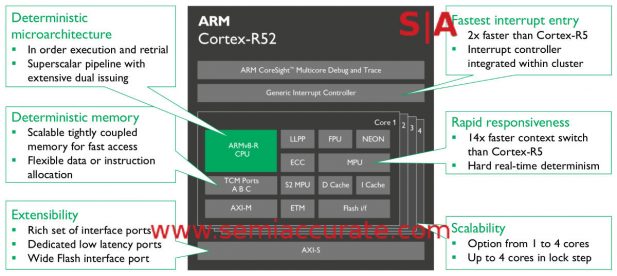
                                               The block diagram of the Cortex-R52


On the surface the R52 looks pretty familiar, four clustered cores, AXI-5 bus, and bunch of memory options. When you dig a little deeper you start seeing differences like the debug and trace block plus an interrupt controller directly on the cluster of CPUs. Even with all of this, v8-R is code directly compatible with v7-R so no rewrite worries for your embedded and certified code. Lets take a look at the high points above and the difference a two makes when going from an R5 to an R52 other than the “up to 35%’ performance uplift”.

First of all there is the deterministic architecture top to bottom which kind of necessitates in-order execution. The R52 is superscalar but it is still in-order so no problems there. What is a really odd addition for those coming from the -A or generalized CPU world is the deterministic memory portion. If you need realtime operation, memory accesses can be a problem. The R52 solves this by adding three TCM or Tightly Coupled Memory ports. If you have an SOC or system you can know your memory latency and adjust your code accordingly. This goes a long way towards a usable deterministic architecture and does a lot to fix memory latency. By fix we mean make consistent, not remove.

Latency is also addressed with the integrated interrupt controller on the cluster. ARM claims what was ~66 cycles of latency for an interrupt with an external IC is now ~27 cycles with the new way. If you think about how a realtime core works, basically sitting in a wait loop until it gets interrupted, this is a massive gain in performance for the system. Similarly a full context switch for a core is now a huge 14x faster than before. More interestingly this latency reduction is not code visible so no changes needed there. Changes in this realm are both costly and require re-certification so again this is a huge win.

On the functionality side there are a lot of improvements too, starting with added crypto instructions. This is necessary to prevent government agencies from illegally recording your antilock brake controller to dashboard blinky-light data stream. That is a joke but we assume there is a need for encryption on a lot of safety critical devices, with the R52 core you now have it along with a few lesser added instructions.

A lot of the new functionality comes from a new privilege level called EL2 which essentially allows v8-R devices to run a hypervisor. We won’t go into why a hypervisor is useful in this realm, it should be pretty obvious. One thing it does do is allow non-realtime and non-safety critical code to run on the same SoC without as much fear but there are probably much better ways to accomplish the same goal. Since the R52 has an AXI-5 bus, you could just add a -M or -A class cluster on the bus and run your movies or infotainment system on that.

Four cores plus a hypervisor in a realtime system essentially equals four discrete systems with nearly ironclad process separation, a really good basis for backup processes, checksums, multiple iterations of the same thing for failovers. Going one step further ARM has put lockstep modes in R52 so you can have two cores each with a shadow core running automatically. Once again this will save SoC designers a lot of headaches because it is not only done for them but done in a standardized way. One thing the R52 can not do is operate in 3-way lockstep for voting type operations but if you need it, you can implement it yourself.

The ease of use bit is a little harder to explain if you are not familiar with realtime cores and programming. In this world code is chunked into regions which are effectively hard separated from each other. You don’t really switch tasks as much as you interrupt something and do a process and go back to waiting on another interrupt. Code is more discrete chunks which define a single task rather than a monolithic blob of everything and the kitchen sink.

To address the ease of use side of this world, the v8-R ISA has made the code regions a lot easier to use. It starts with more flexible region sizes so your code is more likely to live in one region now where it may have had to span multiple regions before. Better yet regions had to be page aligned on v7-R and before, now they only need to be on 64-byte boundaries. This change may require recoding and recertification to take advantage of, but it will simplify the result and make maintenance and updates easier. One time pain, long-term big gains.

ARM introduced v8-R and the first v8-R core, the Cortex-R52
                                                     The trend is obvious

As you can see from the diagram above, in cars code complexity is linearly related to rim diameter which has been increasing rapidly. Seriously though you probably understand why we are on the verge of an explosion in realtime code complexity, ADAS, self-driving, AI based devices, and lots more mean this exponential rise in code, more importantly safety certified realtime code, is not going to slow down any time soon.

To address this, ARM introduced v8-R and the first v8-R core, the Cortex-R52. It may not be 64-bit like v8-A but it doesn’t need to be. What it does need to bring to the table is more performance, lower latencies, and ease of use/programming. It looks like ARM has delivered nicely on all three of these goals for their new ISA and core. With luck your next car will use one and automatically drive to you home rather than through your home.

Read More
Unknown

ARM launches new chip for medical robots and autonomous cars

Japanese-owned chip designer ARM has today unveiled a new chip designed with safety as its key feature.

ARM launches new chip for medical robots and autonomous cars

Unlike standard chipsets, the ARM Cortex-R52 is designed to comply with the most stringent safety standards in the automotive and industrial markets.

Such a chipset is necessary for a number of new emergent computing fields, including self-driving cars and medical robots.

In these fields, compromised code on the chip itself could result in very dangerous consequences when in use.

To mitigate this danger, within the Cortex-R52 chip safety-critical code is fully isolated by ‘hardware-enforced separation’ of software tasks.

“The Cortex-R52 is the first processor built on the ARMv8-R architecture and it was designed from the ground up to address functional safety,” said James McNiven, general manager for CPU at ARM.

While the chips were designed by ARM, the company has already signed a deal with STMicroelectronics for them to be the first licensed manufacturer of the Cortex-R52.

STMicroelectronics themselves noted the security provided by the chips as a key selling point.

“The Cortex-R52’s ability to compartmentalize software provides our users with the best solution for safety without loss of determinism,” said Fabio Marchiò, automotive digital division general manager of STMicroelectronics.

The announcement of this chip comes at a time of growth for autonomous vehicles and other critical robotic systems.

With recent hacking demonstrations showing the relative insecurity of the current chips and software used in these systems, the new ARM chip could find a strong market niche.

The release of the Cortex-R52 also follows ARM’s recent acquisition by Japanese electronics company Softbank.

One of the main drivers of this deal was for Softbank to acquire the chip technology which would underpin the explosion of so-called Internet of Things (IoT) devices.

As autonomous cars and industrial/medical robots are key parts of the IoT ecosystem, this acquisition already appears to be bearing fruit for Softbank.

Further demonstrating the interest in this sector, key rival Intel earlier this year acquired Yogitech, another company which specialized in designing safety chips.
Read More